
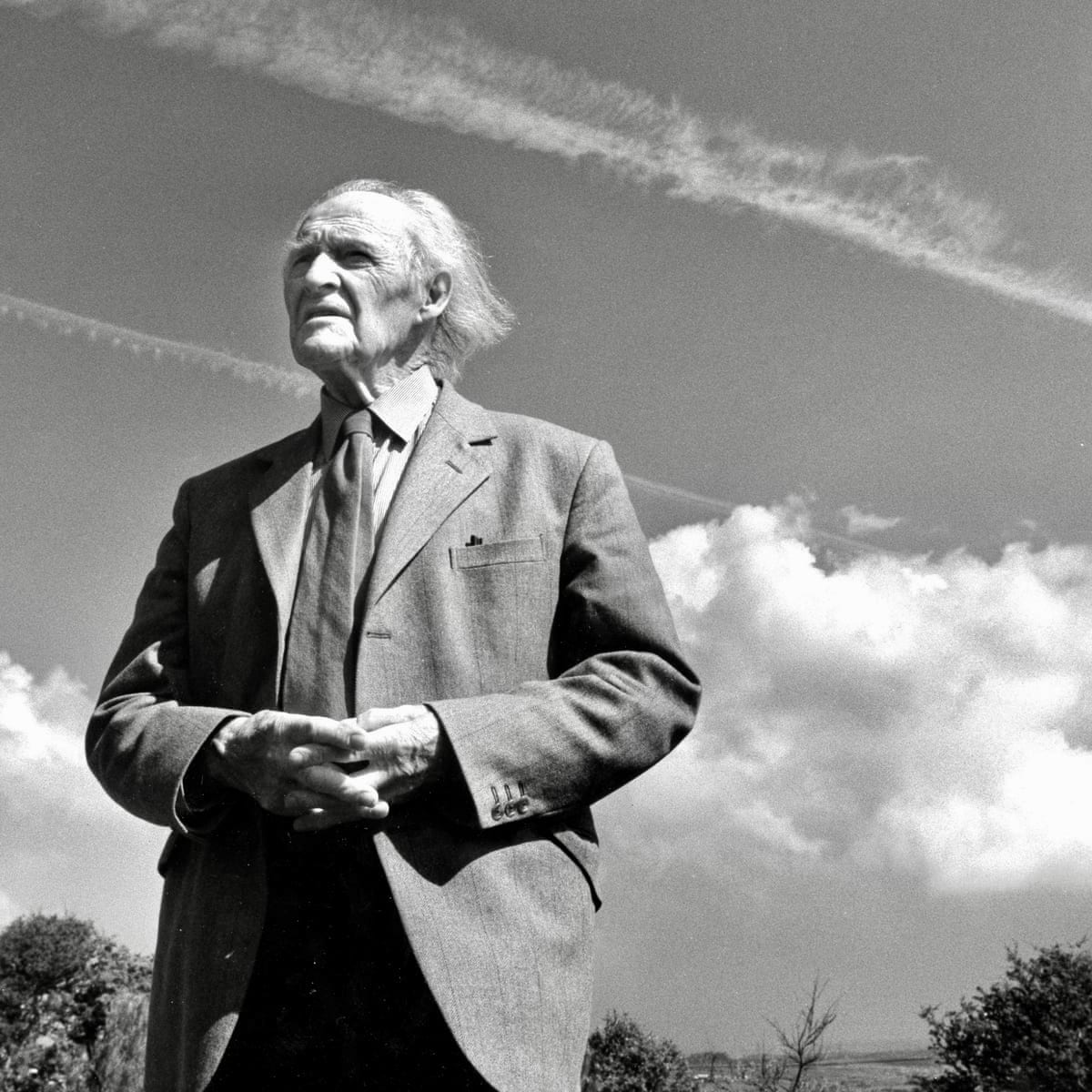
Ronald Stuart Thomas (1913-2000), or R.S. Thomas, the name under which he was published, was a leading British poet of the twentieth century. He wrote about the people of Wales in a style that some critics have compared to that nation’s harsh and rugged terrain. Many of Thomas’s poems set his day-to-day experience against the bleak and forbidding landscape of North Wales, focusing on the difficulties of rural existence, especially on the west coast of the principality. As a clergyman of the Church in Wales, his poetry reveals a religious theme, often reflecting the lonely predicament of a priest who was isolated in his parish. ‘As long as I was a priest of the Church, I felt an obligation to try to present the Bible message in a more or less orthodox way. I never felt that I was employed by the Church to preach my own beliefs and doubts and questionings. Some people were curious to know whether I did not feel some conflict between my two vocations.’[1] But for Thomas, there was a strong link between them.
‘Poetry is religion, religion is poetry. The message of the New Testament is poetry. Christ was a poet, the New Testament is a metaphor, the Resurrection is a metaphor; and I feel perfectly within my rights in approaching my whole vocation as priest and as preacher as one who is to present poetry in its imaginative aspects. The core of both are imagination as far as I’m concerned…. My work as poet has to deal with the presentation of imaginative truth.’[2] Thomas was essentially a poet of the Cross, the unanswered prayer, and the bleak trek through darkness, but also with the occasional glimpse of glory. It is not surprising therefore that he wrote, ‘There is always lurking at the back of my poetry a kind of moralistic or propagandist intention.’[3] He could add, ‘Without darkness, in the world we know, the light would go unprized; without evil, goodness would have no meaning.’‘[4]
His poetry is economic and austere, written in plain, clipped language, with a capacity to strike home in the conscience of the reader. Thomas revealed his method in Words and the Poet: ‘A recurring ideal, I find, is that of simplicity. At times there comes the desire to write with great precision and clarity, words so simple and moving that they bring tears to the eyes, or, if you like, as Wordsworth said, are “too deep for tears”.‘[5] Seeing that religious faith had declined with the emergence of our technological civilization, in 1966 Thomas wrote in the Times Literary Supplement: ‘We are told with increasing vehemence that this is a scientific age, that science is transforming the world, but is it not also a mechanized and impersonal age, an analytic and clinical one; an age in which under the hard gloss of affluence there can be detected the murmuring of the starved heart and the uneasy spirit?’[6]
His poems here record his spiritual struggle with honesty and integrity, but also they provided the context for his moments of faith and vision which are expressed with a penetrating clarity. The headlines to the chapters of this Faith Shaper’s verse derive from the compiler’s paper: ‘Faith Markers on the Evangelical Way: 1215-2021’. In no way are they intended to colonise the poet; they can be found on the Academia platform: www.oxford.academia.edu/IanBunting
Our Father: Hallowed on Earth as in Heaven
The Absence
It is this great absence
that is like a presence, that compels
me to address it without hope
of a reply. It is a room I enter
from which someone has just
gone, the vestibule for the arrival
of one who has not yet come.
I modernise the anachronism
of my language, but he is no more here
than before. Genes and molecules
have no more power to call
him up than the incense of the Hebrews
at their altars. My equations fail
as my words do. What resources have I
other than the emptiness without him of my whole
being, a vacuum he may not abhor?
1978, Frequencies in Collected Poems 1945-1990, London, Dent, 1993.
Song (II)
And God is the weight that bends the bough
of the young tree gently as spring snow.
He is the lightness of the summer flower,
of the bee’s touch, and his the power
that tames the sea and poises like a feather
or a loose leaf the world. He threads together
the stars for necklace and his glory shows,
then hides himself within the cloistered rose.
1946, The Stones of the Field in Collected Poems 1945-1990, London, Dent 1993.
The Peasant
Everyone now asks what will become
Of a world that turns away from God’s sunlight
To look at the endless night,
Without moon, without stars, their unchanging colour
Oppressing the mind. And everyone silent;
Even wise men have the ability
Only to label the dark mystery
That binds the soul with its deadly thread.
But you, my friend, with your peaceful flock
On hill and moor in constant battle
With the merciless earth, – your roots
Shall henceforth keep you safe from the invincible sea
Of that darkness, for what else but the land
Can make men eternally new?
Uncollected Poems, (translated by Jason W. Davies), Tarset, Bloodaxe Books 2013.
Suddenly
Suddenly after long silence
he has become voluble.
He addresses me from a myriad
directions with fluency
of water, the articulateness
of green leaves: and in the genes,
too, the components
of my existence. The rock,
so long speechless, is the library
of his poetry. He sings to me
in the chain-saw, writes
with the surgeon’s hand
on the skin’s parchment messages
of healing. The weather
is his mind’s turbine
driving the earth’s bulk round
and around on its remedial
journey. I have no need
to despair; as at
some second Pentecost
of a Gentile, I listen to the things
round me: weeds, stones, instruments,
the machine itself, all
speaking to me in the vernacular
of the purposes of one who is.
Later Poems 1972-82, London, Macmillan, 1983.
- The Bible: Bestowed Word of God
Indoors
It was easier to come out with you
into the field, where the birds made no claim
on my poor knowledge and flowers grew
with no thought but to declare God.
Within I had the old problems
to cope with: turning from the Book’s
comfortable words, I came face to face
With the proud priests and their intolerant look.
1962 in Uncollected Poems, 2013.
The Minister
Unlike the others my house had a gate
And railings enclosing a tall bush
Of stiff cypress, which the loud thrush
Took as its pulpit early and late.
Its singing troubled my young mind
With strange theories, pagan but sweet,
That made the Book’s black letters dance
To a tune John Calvin never heard.
The evening sunlight on the wall
Of my room was a new temptation.
Luther would have thrown his Bible at it.
I closed my eyes, and went on with my sermon.
1953, The Minister in Collected Poems 1945-90, London, Dent, 1993.
- Jesus Christ: Crucified God in Person
The Coming
And God held in his hand
a small globe. Look, he said.
The son looked. Far off,
as through water, he saw
a scorched land of fierce
colour. The light burned
there; crusted buildings
cast their shadows: a bright
serpent, a river
uncoiled itself, radiant
with slime.
On a bare
hill a bare tree saddened
the sky. Many people
held out their thin arms
to it, as though waiting
for a vanished April
to return to its crossed
boughs. The son watched
them. Let me go there, he said.
1972, H’m in Later Poems 1972-1982, London, Macmillan 1993.
Nativity
Christmas Eve! Five
hundred poets waited, pen
poised above paper,
for the poem to arrive,
bells ringing. It was because
the chimney was too small,
because they had ceased
to believe, the poem had passed them
by on its way out
into oblivion, leaving
the doorstep bare
of all but the sky-rhyming
child to whom later
on they would teach prose.
1992, Mass for Hard Times in Collected Later Poems 1988-2000, Tarset, Bloodaxe Books, 2004.
The Word
Enough that we are on our way;
never ask of us where.
Some of us run, some loiter;
some of us turn aside
to erect the Calvary
that is our signpost, arms
pointing in opposite directions
to bring us in the end
to the same place, so impossible
is it to escape love. Imperishable
scarecrow, recipient of our casts-off,
shame us until what is a swear
word only becomes at last
the word that was in the beginning.
1992, Mass for Hard Times in Collected Later Poems 1988-2000, Tarset, Bloodaxe Books, 2004.
The Musician
… I could see, too, the twitching of the fingers,
Caught temporarily in art’s neurosis,
As we sat there or warmly applauded
This player who so beautifully suffered
For each of us upon his instrument.
So it must have been on Calvary
In the fiercer light of the thorns’ halo:
The men standing by and that one figure,
The hands bleeding, the mind bruised but calm,
Making such music as lives still.
And no one daring to interrupt
Because it was himself that he played
And closer than all of them God listened.
1961, Tares in Collected Poems 1945-90, London, Dent, 1993.
Crucifixion
Not the empty tomb
but the uninhabited
cross. Look long enough
and you will see the arms
put on leaves. Not a crown
of thorns but a crown of flowers
haloing it, with a bird singing
as though perched on paradise’s threshold.
Collected Later Poems 1988-2000, Tarset, Bloodaxe Books, 2004.
Aftermath
Easter. The grave-clothes of winter
are still here, but the sepulchre
is empty. A messenger
from the tomb tells us
how a stone has been rolled
from the mind and a tree lightens
the darkness with its blossom.
There are travellers upon the roads
who have heard music blown
from a bare bough and a child
tells us how the accident
of last year, a machine stranded
beside the way for lack of
petrol, is covered with flowers.
1995 No Truce with the Furies, Tarset, Bloodaxe 1995.
- Humanity: Sinful, Rebellious and Faithless
The Word
A pen appeared, and the god said:
‘Write what it is to be
man.’ And my hand hovered
long over the bare page,
until there, like footprints
of the lost traveller, letters
took shape on the page’s
blankness, and I spelled out
the word ‘lonely’. And my hand moved
to erase it; but the voices
of all those waiting at life’s
window cried out loud: ‘It is true.’
Collected Poems 1945-90, London, Dent, 1993.
The Way of it
Last night the talk
was of the relationship of the self
to God, tonight of God
to the self. The centuries
yawn. Alone in the corner
one sit whose silence persuades
of the pointlessness
of the discourse. He drinks
at another fountain.
1977 in Later Poems 1972-1982, London, Macmillan,1983.
Stop Press
All the papers carry it
In naked letters: God’s bluff
called at last. The bedroom
with the words over the door:
Do not disturb – has been forced
by science and found to be
empty. Man celebrates the ending
of his tiptoe existence.
The world has become a window
of plain glass for more and more
people to press their faces against
laughing and crying: There is nothing there.
1979, Uncollected Poems, Tarset, Bloodaxe Books, 2013.
Kyrie
Because we cannot be clever and honest
and are inventors of things more intricate
than the snowflake – Lord have mercy.
Because we are full of pride
in our humility, and because we believe
in our disbelief – Lord have mercy.
Because we will protect ourselves
from ourselves to the point
of destroying ourselves – Lord have mercy.
And because on the slope to perfection,
when we should be half-way up,
we are half-way down – Lord have mercy.
Mass for Hard Times in Collected Later Poems 1988-2000, Tarset, Bloodaxe Books, 2004.
The Big Preachers
… And the people hungered
for more, exposing themselves Sunday
by Sunday to that tempestuous
weather, sharpening their appetite
thereby. You have heard the story
of the visiting preacher’s drawing
of a pretended bow, and how they parted
for the shaft to go by? Those
were the imagination’s heydays
and will not return. Being too thick
to give ground, we take our stand
now on the facts, and the facts
must do for us, a multitude at a time.
1983 in Uncollected Poems, Tarset, Bloodaxe Books, 2013.
The Answer
Not darkness but twilight
in which even the best
of minds must make its way
now. And slowly the questions
occur, vague but formidable
for all that. We pass our hands
over their surface like blind
men, feeling for the mechanism
that will swing them aside. They
yield, but only to re-form
as new problems; and one
does not even do that
but towers immovable
before us.
Is there no way
other than thought of answering
its challenge? There is an anticipation
of it to the point of
dying. There have been times
when, after long on my knees
in a cold chancel, a stone has rolled
from my mind, and I have looked
in and seen the old questions lie
folded and in place
by themselves, like the piled
grave clothes of love’s risen body.
1978 Frequencies in Later Poems, 1972-1982, London, Macmillan, 1983.
Adjustments
… We never catch
him at work, but can only say,
coming suddenly upon an amendment
that here he has been….
Patiently with invisible structures
he builds, and as patiently
we must pray, surrounding the ordering
of the ingredients to a wisdom that
is beyond our own. We must change the mood
to the passive.
1978 Frequencies in Later Poems 1972-1982, London, Macmillan, 1983.
- The Grace of God: Justifying and Converting
When we are weak, we are
strong. When our eyes close
on the world, then somewhere
within us the bush
burns. When we are poor
and aware of the inadequacy
of our table, it is to that
uninvited the guest comes.
1990 Counterpoint in Collected Later Poems 1988-2000, Tarset, Bloodaxe Books, 2004.
- Christian Living: Progressive Christ-likeness
Emerging
…I would have knelt
long, wresting with you, wearing
you down. Hear my prayer, Lord, hear
my prayer. As though you were deaf, myriads
of mortals have kept up their shrill
cry, explaining your silence by
their unfitness.
It begins to appear
this is not what prayer is about.
It is an annihilation of difference,
the consciousness of myself in you,
and you in me….
1975 Frequencies in Collected Poems 1945-90, London, Dent, 1993.
Coming True
… The universe is
our parish, and each of us
is his own church with an altar
waiting for the sacrifice of his superstition.
Uncollected Poems, Tarset, Bloodaxe Books, 2013.
- Holy Spirit: in Christian Experience
Ann Griffith (1776-1805)
… These people know me
only in the thin hymns of
the mind, in the arid sermons
and prayers. I am the live God,
nailed fast to the old tree
of a nation by its unreal
tears. I thirst, I thirst
for the spring water. Draw it up
for me from your heart’s well and I will change
it to wine upon your unkissed lips.
Collected Poems 1945-90, London, Dent, 1993.
8. Believers: Assured, Called and Prayerful
The Other
There are nights that are so still
that I can hear the small owl calling
far off, and a fox barking
miles away. It is then that I lie
in the lean hours awake, listening
to the swell born somewhere in the Atlantic,
rising and falling, rising and falling,
wave on wave on the long shore,
by the village that is without light
and companionless. And the thought comes
of that other being who is awake too,
letting our prayers beat on him,
not like this for a few hours,
but for days, years, for eternity.
1988 The Echoes Return Slow in Collected Poems 1945-90, London, Dent, 1993.
‘Any message, any advice to offer? Nothing’, But….
After all, there is nothing more important than the relationship between man and God. Nor anything more difficult than establishing that relationship. Who is it that ever saw God? Who ever heard Him speak? We have to live virtually the whole of our lives in the presence of an invisible and mute God. But that was never a bar to anyone seeking to come into contact with Him. That is what prayer is.
Autobiographies: No-one, (1985) in Welsh, translated by Jason Walford Davies, London, J.M. Dent, 1997, p.104.
Tidal
The waves run up the shore
and fall back. I run
up the approaches of God
and fall back. The breakers return
reaching a little further,
gnawing away at the main land.
They have done this thousands
of years, exposing little by little
the rock under the soil’s face.
I must imitate them only
in my return to the assault,
not in their violence. Dashing
my prayers at him will achieve
little other than exposure
of the rock under his surface.
My returns must be made
on my knees. Let despair be known
as my ebb-tide; but let prayer
have its springs, too, brimming,
disarming him; discovering somewhere
among his fissures deposits of mercy
where trust may take root and grow.
1992 in Mass for Hard Times in Collected Later Poems 1988-2000, Tarset, Bloodaxe Books, 2004.
- The Necessity of the Church
Indoors
It was easier to come out with you
into the field, where the birds made no claim
on my poor knowledge and flowers grew
with no thought but to declare God.
Within I had the old problems
to cope with: turning from the Book’s
comfortable words, I came face to face
With the proud priests and their intolerant look.
1962 in Uncollected Poems, (eds. Tony Brown & Jason W. Davies), Tarset, Bloodaxe Books, 2013.
In a Country Church
Was he baulked by silence? He kneeled long
And saw love in a dark crown
Of thorns blazing, and a winter tree
Golden with fruit of a man’s body.
1955, Song at the Year’s Turning in Collected Poems 1945-90, London, Dent, 1993.
The Country Clergy
I see them working in old rectories
by the sun’s light, by candlelight,
venerable men, their black cloth
a little dusty, a little green
with holy mildew. And yet their skulls,
ripening over so many prayers, toppled into the same grave
with oafs and yokels. They left no books,
memorial to their lonely thought
in grey parishes; rather they wrote
on men’s hearts and in the minds
of young children sublime words
too soon forgotten. God in his time
or out of time will correct this.
1958, Poetry for Supper in Collected Poems 1945-90, London, Dent, 1993.
I was vicar of large things in a small parish.
Small-minded I will not say;
there were depths in some of them I shrank back from,
wells that the word ‘God’ fell into and died away,
and for all I know is still falling.
Who goes for water to such must prepare for a long wait.
Their eyes looked at me and were the remains of flowers on an old grave.
I was there, I felt,
to blow on ashes that were too long cold.
Often, when I thought they were about to unbar me,
the draught out of their empty places came whistling,
so that I wrapped myself in the heavier clothing of my calling,
speaking of light and love
in the thickening shadows of their kitchens.
1988, The Echoes Return Slow in Collected Later Poems 1988-2000, Tarset, Bloodaxe Books, 2004.
Service
We stand looking at
each other. I take the word ‘prayer’
and present it to them. I wait idly
what their lips will
make of it. But they hand back
such presents. I am left alone
with no echoes to the amen
I dreamed of. I am saved by the music
from the emptiness of this place
of despair. As the melody rises
from nothing, their mouths take up the tune,
and the roof listens. I call on God
in the after silence, and my shadow
wrestles with him upon a wall
of plaster, that has all the nation’s
hardness in it. They see me thrown
without movement of their oblique eyes.
Collected Poems 1945-90, London, Dent, 1993, Eglwys Fach 1954-1967. Cited in Byron Rogers, The Man who Went into the West: The Life of R.S. Thomas. London, Aurum Press, 2006, p. 217.
The Priest
… ‘Crippled soul,’ do you say? Looking at him
from the mind’s height; ‘limping through life
on his prayers. There are other people
in the world sitting at table
contented, though the broken body
and the shed blood are not on the menu.’
‘let it be so,’ I say. ‘Amen and amen.’
Collected Poems 1945-90, London, Dent, 1993.
Post-war Nonconformist ministry in Wales – a comment
They chose their pastors as they chose their horses
for hard work. But the last one died
sooner than they expected; nothing sinister,
You understand, but just the natural
breaking of the heart beneath a load
unfit for horses, ‘Ay, he’s a good ‘un’,
Job Davies had said, and Job was a master
hand at choosing a nag or a pastor.
BBC Welsh Home Service 18.09.1952, published 1953. Selected Poems 1946-1968, London: Hart-Davis MacGibbon, 1973, Reprinted Tarset, Bloodaxe Books,1986.
- The Mission of God
The Chapel
A little aside from the main road,
be-calmed in a last-century greyness,
there is the chapel, ugly, without the appeal
to the tourist to stop his car
and visit it. The traffic goes by,
and the river goes by, and quick shadows
of clouds, too, and the chapel settles
a little deeper into the grass.
But here once on an evening like this,
in the darkness that was about
his hearers, a preacher caught fire
and burned steadily before them
with a strange light, so that they saw
the splendour of the barren mountains
about them and sang their Amens
fiercely, narrow but saved
in a way that men are not now.
1975, Laboratories of the Spirit in Collected Poems 1945-90, London, Dent, 1993.
The Minister
I was the chapel pastor, the abrupt shadow
staining the neutral fields, troubling the men
who grew there with my glib dutiful praise
of a fool’s world; a man ordained for ever
to pick his way along the grass-strewn wall
dividing tact from truth.
I knew it all,
although I never pried, I knew it all.
I knew why Buddug was away from chapel.
I knew that Pritchard, the Fron, watered his milk.
I knew who put the ferret with fowls
in Pugh’s hen-house. I knew and pretended I didn’t.
and they knew that I knew and pretended I didn’t.
They listened to my preaching the unique gospel
of love; but our eyes never met. And outside
the blood of God darkened the evening sky.
BBC Welsh Home Service 18.09.1952, published 1953.
Selected Poems 1946-1968, London, Hart-Davis, MacGibbon 1973 Reprinted: Tarset, Bloodaxe Books, 1986.
Collected Poems 1945-90, London, Dent, 1993.
- The Vision of Moral Justice
The Kingdom
It’s a long way off, but inside it
there are quite different things going on:
festivals at which the poor man
is king and the consumptive
is healed; mirrors in which the blind look
at themselves and loves looks at them
back; and industry is for mending
the bent bones and the minds fractured
by life. It’s a long way off, but to get
there takes no time, and admission
is free if you purge yourself
of desire and present yourself with
your need only and the simple offering
of your faith, green as a leaf.
Collected Poems 1945-90, London, Dent, 1993.
- Glory: Here and There, Now and Then
Resurrections
Easier for them, God
only at the beginning
of his recession. Blandish him,
said the times and they did so,
Herbert Traherne, walking
in a garden not yet
polluted. Music in Donne’s
Mind was still polyphonic.
The corners of the spirit waiting
to be developed, Hopkins
renewed the endearments
taming the lion-like presence
lying against
him. What
happened? Suddenly he was
gone, leaving love guttering
in his withdrawal. And scenting
disaster, as flies are attracted
to a carcass, far down
in the subconscious ghouls
and the demons we thought
we had buried for ever resurrected.
1995, No Truce with the Furies in Collected Later Poems 1988-2000, Tarset, Bloodaxe Books, 2004.
Geriatric
What god is proud
of this garden
of dead flowers, this underwater
grotto of humanity,
where limbs wave in invisible
currents, faces drooping
on dry stalks, voices clawing
in a last desperate effort
to retain hold? Despite withered
petals, I recognise
the species: Charcot, Meniere
Alzheimer. There are no gardeners
Here, caretakers only
of reason overgrown
by confusion. This body once,
when it was in bud,
opened to love’s kisses. These eyes
cloudy with rheum,
were clear pebbles that love’s rivulet
hurried over. Is this
the best Rabbi Ben Ezra
promised? I come away
comforting myself, as I can,
that there is another
garden, all dew and fragrance,
and that these are the brambles
about it we are caught in,
a sacrifice prepared
by a torn god to a love fiercer
than we can understand.
1995 No Truce with the Furies in Collected Later Poems 1988-2000, Tarset, Bloodaxe Books, 2004.
Self-Portrait
Time running out
now, and the soul
unfinished. And the heart knows
this is not the portrait
it posed for. Keep the lips
firm; too many disappointments
have turned the mouth down
at the corners. There is no surgery
can mend those lines: cruelly
the light fingers them and the mind
winces.
Laboratories of the Spirit, London, Macmillan, 1975.
Pilgrimages
There is an island there is no going
to but in a small boat the way
the saints went, travelling the gallery
of the frightened faces of
the long drowned, munching the gravel
of its beaches. So I have gone
up the salt lane to the building
with the stone altar and the candles
gone out, and kneeled and lifted
my eyes to the furious gargoyle
of the owl that is like a god
gone small and resentful. There
is no body in the stained window of the sky now.
Am I too late?
Were they too late also, those
first pilgrims? He is such a fast
God, always before us and
leaving as we arrive.
There are those here
not given to prayer, whose office
is the blank sea that they say daily.
What they listen to is not
hymns but the slow chemistry of the soil
that turns saints’ bones to dust.
Collected Poems 1945-90, London, Dent, 1993.
The Bright Field
I have seen the sun break through
to illuminate a small field
for a while, and gone my way
and forgotten it. But that was the pearl
of great price, the one field that had
the treasure in it. I realise now
that I must give all I have
to possess it. Life is not hurrying
on to a receding future, nor hankering after
an imagined past. It is the turning
aside like Moses to the miracle
of the lit bush, to a brightness
that seemed as transitory as your youth
once, but is the eternity that awaits you.
Later Poems 1972 – 1982, London, Macmillan, 1983.
[1] R.S. Thomas: Contemporary Authors Autobiographical Series: London, J.M. Dent, 1995.
[2] ‘R.S. Thomas: Priest and Poet’, John Ormond Film, BBC, 2nd April 1972. Cited in William V. Davis (ed.), Miraculous Simplicity: Essays on R.S. Thomas, Fayetteville, University of Arkansas Press, 1993, p. 111.
[3] R.S. Thomas, Words and the Poet, W.D. Thomas Memorial Lecture, 19th November1963, Cardiff, University of Wales Press, 1964, p. 21.
[4] The Penguin Book of Religious Verse, Introduced and edited by R.S. Thomas, Harmondsworth, Penguin, 1963, p.11.
[5] R.S. Thomas, Words and the Poet, 1964, pp. 22-23.
[6] ‘A Frame for Poetry’, in R.S. Thomas, Selected Prose, Sandra Antsey (ed.), Bridgend, Poetry Wales P., 1983, 93.
Tares, London, Hart-Davis, 1961.
The Penguin Book of Religious Verse: Introduced and Edited by by R.S. Thomas, Harmondsworth, Penguin Books, 1963.
H’m, London, Macmillan, 1972.
Laboratories of the Spirit, London, Macmillan, 1975.
Frequencies, London, Macmillan, 1978.
Later Poems 1972-82, London, Macmillan, 1993.
Collected Poems 1945-1990, London, J.M. Dent, 1993,
No Truce with the Furies, Tarset, Bloodaxe Books, 1995.
Collected Later Poems 1988-2000, Tarset, Bloodaxe Books, 2004.
Uncollected Poems, (eds. Tony Brown & Jason W. Dav,es), Tarset, Bloodaxe Books, 2013,
Etched by Silence: A pilgrimage through the poetry of R.S. Thomas, Compiled by Jim Cotter, Norwich, Canterbury Press, 2013.

0 Comments