
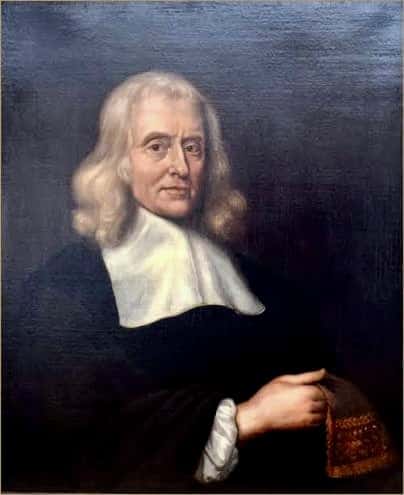
John Milton rejected the faith of his Roman Catholic father. He became a strongly Protestant Puritan, and a radical Christian with regard to the contemporary culture and powers in the land, including the Crown, Parliament and the Church. Although in 1630, he subscribed to the liturgy and doctrine of the Church of England and accepted the royal supremacy, he became fiercely anti-papal, and a revolutionary anti-monarchist. As an orthodox Calvinist of his period, he opposed the power and position of Church of England, accepted the God-given authority of the English translation of the Bible (1611), and upheld the right of Christians to interpret it.
As a writer of prose and poetry, John Milton’s works span four periods of history and Stuart England; the Civil War (1642-1648), the Commonwealth (1649-1653), the Protectorate (1654-1660), and the Restoration of the Monarchy. His politically focused prose was composed in the decades of the 1640s and 1650s, during the strife between the Church of England and various reformist groups. These anti-episcopal and anti-monarchical tracts promote a distinct freedom of conscience and high degree of civil liberty for humankind in the face of various ecclesiastical and governmental forms of tyranny and oppression. By 1652 Milton was totally blind.
Reputed to have been a poet from the age of ten, by his education Milton was a classicist and a humanist. He was a passionate lover of beauty and goodness, and he did not share the contemporary Puritan contempt for the stage. Therefore, while possessing all the moral earnestness and religious zeal of the Puritan, his interests were wide. He could employ common classical metaphors in his Biblical epics, for example ‘Nature’ and ‘Fate’, as useful figures of speech for God. Reason was the chief faculty through which he understood and expressed his traditional Christian belief and outlook, but he recognised its limitations:
For Understanding ruled not, and the Will
Heard not her lore, both in subjection now
To sensual Appetite, who, from beneath
Usurping over Sovran Reason, claimed
Superior sway.[1]
Inevitably, he was highly critical of the political and religious establishments of his day but deeply committed to the pursuit of righteousness in every walk of life, both personal and public. The edition of his works in this anthology was published in 1994 by Wordsworth Editions, Ware.
The headlines to the sections in this Faith Shaper’s verse derive from, and are explained in the compiler’s paper: ‘Faith Markers on the Evangelical Way: 1375-2021’, to be found on the Academia platform, www.oxford.academia.edu/IanBunting This selection of Milton’s verse is not an attempt to ‘colonise’ the poet, but rather a collection revealing essential Christian truths in the work of a classic English ‘faith shaper’ of the seventeenth century, and indeed of the centuries which have followed.
- Our Father: Hallowed on Earth as in Heaven
A Mask presented at Ludlow Castle in 1634
…If all the world
Should, in a pet of temperance, feed on pulse,
Drink the clear stream, and nothing wear but frieze,
Th’allgiver would be unthanked, would be unpraised,
Not half his riches known, and yet despised;
And we should serve him as a grudging master,
As a penurious niggard of his wealth,
And live like Nature’s bastards, not her sons….,
Beauty is Nature’s coin: must not be horded,
But must be current; and the good thereof
Consists in mutual and partaken bliss,
Unsavoury in th’ enjoyment of itself.
If you let slip time, like a neglected rose
It withers on the stalk, with languished head.
Beauty is Nature’s brag, and must be shown
In courts, at feasts, and high solemnities,
Where most may wonder at the workmanship….
Comus: A Mask, 1634, Lines 720-727 & 739-747.
‘God sends his Son with glory, and attendance of Angels, to perform the work of creation in six days: the Angels celebrate with hymns the performance thereof, and his reascension into Heaven’.[2]
There wanted yet the master-work, the end
Of all yet done – a creature who, not prone
And brute as other creatures, but endued
With sanctity of reason, might erect
His stature, and upright with front serene
Govern the rest, self-knowing, and from thence
Magnanimous to correspond with Heaven,
But grateful to acknowledge whence his good
Descends; thither with heart, and voice, and eyes
Directed to devotion, to adore
And worship God supreme, who made him chief
Of all his works….
Paradise Lost, 1667, Book VII, Lines 505-515.
- The Bible: Bestowed Word of God
The Son of God muses… ‘how best the mighty work he might begin of Saviour to mankind.’[3]
O what a multitude of thoughts at once
Awakn’d in me swarm, while I consider
What from within I feel my self, and hear
What from without comes often to my ears,
Ill sorting with my present state compar’d.
When I was yet a child, no childish play
To me was pleasing, all my mind was set
Serious to learn and know, and thence to do
What might be publick good; my self I thought
Born to that end, born to promote all truth,
All righteous things: therefore above my years,
The Law of God I read, and found it sweet,
Made it my whole delight, and in it grew
To such perfection, that e’re yet my age
Had measured twice six years, at our great Feast
I went into the Temple, there to hear
The teachers of our Law, and to propose
What might improve my knowledge or their own….
Paradise Regained, 1671, Book I, Lines 196-213.
The ‘Fiend’ tests the Son of God: ‘These rules will render thee a king complete within thyself, much more with empire joined.’[4]
… The childhood shows the man,
As morning shows the day: be famous then,
By wisdom; as thy empire must extend,
So let extend thy mind o’er all the world,
In knowledge, all things in it comprehend;
All knowledge is not couched in Moses’ law,
The Pentateuch, or what the Prophets wrote;
The Gentiles also know, and write, and teach
To admiration, led by Nature’s light;
And with the Gentiles much thou must converse,
Ruling them by persuasion, as the mean’st.
Without their learning, how wilt thou with them
Or they without thee, hold conversation meet?
How wilt thou reason with them, how refute
Their idolisms, traditions, paradoxes?
Error by his own arms is best evinced.
Paradise Regained, 1671, Book IV, Lines 220 -235.
- Jesus Christ: Crucified God in Person
‘God… declares that grace cannot be extended towards Man without the satisfaction of Divine Justice; Man hath offended the majesty of God by aspiring to Godhead, and therefore, with all his progeny, devoted to death, must die unless someone can be found sufficient to answer for his offence, and undergo his punishment. The Son of God freely offers himself a ransom for Man: The Father accepts him, ordains his incarnation, pronounces his exaltation above all names in Heaven and Earth….’[5]
Thee, Father, first they sung Omnipotent,
Immutable, Immortal, Infinite,
Eternal King; the Author of all being,
Fountain of light, thyself invisible
Amidst the glorious brightness where thou sit’st
Throned inaccessible, but when thou shadest
The full blaze of thy beams, and, through a cloud
Drawn round about thee like a radiant shrine,
Dark with excessive bright thy skirts appear,
Yet dazzle Heaven, that brightest Seraphim
Approach not, but with both wings veil their eyes.
Thee next they sang of all creation first,
Begotten Son, Divine Similitude,
In whose conspicuous countenance, without cloud
Made visible, the Almighty Father shines,
Whom else no creature can behold; on thee
Impressed the effulgence of his glory abides,
Transfused on thee his ample Spirit rests.
He Heaven of Heavens and all the Powers therein
By thee created; and by thee threw down
The aspiring Dominations….
Paradise Lost, Book III, 1667, Lines 306-309 & 372-392.
On the Morning of Christ’s Nativity[6]
Yea, Truth and Justice then
Will down return to men,
Orbed in a rainbow; and, like glories wearing,
Mercy will sit between,
Throned in celestial sheen,
With radiant feet the tissued clouds down-steering,
And Heaven, as at some festival,
Will open wide the gates of her high palace-hall.
But wisest Fate says No,
This must not yet be so,
The Babe lies yet in smiling infancy,
That on bitter cross
Must redeem our loss,
So both Himself and us to glorify:
Yet first to those ychained in sleep,
The wakeful trump of doom must thunder through the deep….
When at the world’s last session,
The dreadful Judge in middle air shall spread His throne.
And then at last our bliss
Full and perfect is,
But now begins; for from this happy day
Th’ old Dragon under-ground
In straiter limits bound,
Not half so far casts his usurped sway,
And, wroth to see his kingdom fail,
Swinges the scaly horror of his folded tail.
Verses XV-XVII, 1629, Lines 141-156 & 163-172
Satan malcontent: ’I see what I can do or offer is suspect….’[7]
‘…And all thy heart is set on high designs,
High actions: but wherewith to be achieved?
Great acts require great means of enterprise;
Thou art unknown, unfriended, low of birth,
A carpenter thy father known, thyself
Bred up in poverty and straits at home;
Lost in a desert hers, and hunger-bit
Which way, or from what hope dost thou aspire
To greatness? Whence authority deriv’st?
What followers, what retinue canst thou gain,
Or at thy heels the dizzy multitude,
Longer than thou canst feed them on thy cost?
Money brings honour, friends, conquest and realms….
They whom I favour thrive in wealth amain,
While virtue, valour, wisdom, sit in want.’
To whom thus Jesus patiently replied:-
‘Yet wealth without these three is impotent
To gain dominion, or to keep it gained….’
Paradise Regained, 1671, Book II, Lines 410-423 & 430-434.
‘Tempt not the Lord thy God.’ He said and stood; But Satan, smitten with amazement, fell.’[8]
Who then thou art, whose coming is foretold
To me so fatal, me it most concerns.
The trial hath endamaged thee no way,
Rather more honour left and more esteem;
Me naught advantaged, missing what I aimed.
Thus they the Son of God, our Saviour meek,
Sung victor, and, from heavenly feast refreshed,
Brought on his way with joy; he, unobserved,
Home to his mother’s house private he returned.
Paradise Regained, 1671, Book IV, Lines 204-208, 636-639.
- Humankind: Sinful, Rebellious and Faithless
Arch-Fiend to his colleague who led the war and ‘endangered Heaven’s perpetual King,’[9]
Fall’n Cherub, to be weak is miserable,
Doing or suffering: but of this be sure –
To do aught good never will be our task,
But ever to do ill our sole delight,
As being contrary to his high will
Whom we resist. If then his providence
Out of our evil seek to bring forth good,
Our labour must be to pervert that end,
And out of good still find means of evil;
Which oft-times may succeed so as perhaps
Shall grieve him, if I fail not, and disturb
His inmost counsels from their destined aim.
Paradise Lost, 1667, Book I, Lines 157-168.
Human complicity with ‘Heaven-warring champions: Satan whom now transcendent glory raised above his fellows, with monarchal pride conscious of highest worth… thus spake:[10]
O shame to men! Devil with devil damned
Firm concord holds; men only disagree
Of creatures rational, though under hope
Of heavenly grace, and, God proclaiming peace,
Yet live in hatred, enmity, and strife
Among themselves, and levy cruel wars,
Wasting the earth, each other to destroy:
As if (which might induce to accord)
Man had not hellish foes enough besides,
That day and night for his destruction wait!
Paradise Lost, 1674, Book II, Lines 496-505.
‘ Now conscience wakes despair that slumbered; wakes the bitter memory of what he was, what is, and what must be worse’.[11]
‘O thou that, with surpassing glory crowned,
Look’st from thy sole dominion like the god
Of this new World – at whose sight all the stars
Hide their diminished heads – to thee I call,
But with no friendly voice, and add thy name,
O Sun, to tell thee how I hate thy beams
That bring to my remembrance from what state
I fell, how glorious once above thy sphere,
Till pride and worse ambition threw me down,
Warring in Heaven against Heaven‘s matchless King.’
Paradise Lost, 1674, Book IV, Lines 23-24 & 32-41.
The ‘Fiend’ tests the Son of God with the example of Socrates, ‘whom, well inspired, the oracle pronounced Wisest of men; from whose mouth issued forth mellifluous streams that watered all the schools of Academics old and new, with those surnamed Peripatetics, and the sect Epicurean, and the Stoic severe…. These rules will render thee a king complete within thyself, much more with empire joined.’[12]
… our Saviour sagely thus replied:-
‘Think not that I know these things; or think
I know them not, not therefore am I short
Of knowing what I ought: he who receives
Light from above, from the Fountain of Light,
No other doctrine needs, though granted true;
But these are false, or little else but dreams,
Conjectures, fancies, built on nothing firm…
The first and wisest of them all professed
To know this only, that he nothing knew;
The next to fabling fell and smooth conceits;
A third sort doubted all things, though plain sense;
Others in virtue placed felicity,
But virtue joined with riches and long life;
In corporal pleasure he, and careless ease;
The Stoic last in philosophic pride,
By him called virtue, and his virtuous man,
Wise, perfect in himself, and all possessing,
Equal to God, oft shames not to prefer,
As fearing God nor man, contemning all
Wealth, pleasure, pain or torment, death and life-
Alas! What can they teach, and not mislead,
Ignorant of themselves, of God much more,
And how the world began, and how Man fell,
Degraded by himself, on grace depending?
Much of the soul they talk, but all awry;
And in themselves seek virtue; and to themselves
All glory arrogate, to give God none;
Rather accuse him under usual names,
Fortune and Fate, as one regardless quite
Of mortal things….
Paradise Regained, 1671, Book IV, 285-292, 300 & 309-315.
‘On the Detraction which followed upon my writing certain treatises’[13]
I did but prompt the age to quit their clogs
By the known rules of ancient liberty,
When straight a barbarous noise environs me
Of owls, and cuckoos, asses, apes and dogs….
That bawl for freedom in their senseless mood,
And still revolt when Truth would set them free,
Licence they mean when they cry Liberty;
For who loves that must first be wise and good:
But from that mark how far they rove we see,
For all this waste of wealth, and loss of blood.
Sonnet 12, 1673, lines 1-4 & 9-14.
‘Michael in either hand leads them out of Paradise, the fiery sword waving behind them, the Cherubim taking their stations to guard the place.’[14]
Adam and Eve
The world was all before them, where to choose
Their place of rest, and providence their guide:
They, hand in hand, with wandering steps and slow,
Through Eden took their solitary way.
Paradise Lost, 1674, Book XII, 636-639, The End.
5. The Grace of God: Justifying and Converting
Michael: ‘Doubt not but that sin will reign among them, as of thee begot;’
Law can discover sin but not remove,
Save by those shadowy expiations weak,
The blood of bulls and goats, they may conclude
Some blood more precious must be paid for Man.
Just for unjust, that in such righteousness,
To them by faith imputed, they may find
Justification towards God, and peace
Of conscience, which the law by ceremonies
Cannot appease, nor Man the moral part
Perform, and, not performing, cannot live.
So Law appears imperfect, and but given
With purpose to resign them, in full time,
Up to a better cov’nant, disciplined
From shadowy types to truth, from flesh to spirit,
From imposition of strict laws to free
Acceptance of large grace, from servile fear
To filial, works of law to works of faith.
Paradise Lost, 1674, Book XII, Lines 285-286 & 290-306.
God, to render Man inexcusable, sends Raphael to admonish him of his obedience, of his free estate, of his enemy near at hand, who he is, and why his enemy, and whatever else may avail Adam to know.…[15]
‘Son of Heaven and Earth,
Attend! That thou art happy, owe to God;
That thou continues such, owe to thyself,
That is to thy obedience; therein stand.
This was that caution given thee; be advised….
On other surety none: freely we serve,
Because we freely love, as in our will
To love or not; in this we stand or fall….
Paradise Lost, 1674, Book V, Lines 520-523 & 538-540.
‘Satan’s first sight of Adam and Eve; his wonder at their excellent form and happy state, but with resolution to work their fall….’ from ’Heaven’s matchless King’.[16]
What could be less than to afford him praise,
The easiest recompense, and pay him thanks,
How due! Yet all his good proved ill in me,
And wrought but malice; lifted up so high,
I ‘sdained subjection, and thought one step higher
Would set me highest, and in a moment quit
The debt immense of endless gratitude,
So burdensome, still paying, still to owe;
Forgetful what from him I still received;
And understood not that a grateful mind
By owing owes not, but still pays, at once
Indebted and discharged; what burden then?
Paradise Lost, 1674, Book IV, 54-57.
- Christ-likeness: Progressive Christian Living
The First Book proposes, first in brief, the whole subject:- Man’s disobedience, and the loss thereupon of Paradise wherein he was placed; then touches the prime cause of his fall – the Serpent, or rather Satan in the Serpent.[17]
Of Man’s first disobedience, and the fruit
Of that forbidden tree, whose mortal taste
Brought death into the world, and all our woe,
With loss of Eden, till one greater Man
Restore us, and regain the blissful seat
Sing, Heavenly Muse….
Thou O Spirit, thou that dost prefer
Before all temples th’upright heart and pure,
Instruct me, for Thou know’st; Thou from the first
Wast present, and, with mighty wings outspread,
Dove-like sat’st brooding on the vast Abyss
And mad’st it pregnant: what in me is dark
Illumine, what is low raise and support;
That, to the height of this great argument,
I may assert Eternal Providence,
And justify the ways of God to men.
Paradise Lost, 1674, Book I, Lines 1-6 & 17-26
A Mask: The first Scene discovers a wild wood
Virtue could see to do what Virtue would
By her own radiant light, though sun and moon
Were in the flat sea sunk. And Wisdom’s self
Oft seeks to sweet retired solitude,
Where with her best nurse Contemplation,
She plumes her feathers, and lets grow her wings
That in the various bustle of resort
Were all to-ruffled, and sometimes impaired.
He that has light within his own clear breast
May sit i’ the centre, and enjoy bright day:
But he that hides a dark soul, and foul thoughts,
Benighted walks under the midday sun;
Himself is his own dungeon.
Comus: A Mask, (1637), Lines 373-385.
Adam sadly shares with Eve his uncouth dream ‘of evil sprung, I fear;’
Yet evil whence? In thee can harbour none
Created pure. But know that in the soul
are many lesser faculties, that serve
reason as chief. Among these fancy next
her office holds; of all external things,
which the five watchful senses represent,
she forms imaginations, aery shapes,
which reason, joining or disjoining, frames
all what we affirm, of what deny, and call
our knowledge or opinion; then retires
into her private cell when nature rests.
Oft in her absence, mimic fancy wakes
To imitate her; but, misjoining shapes,
Wild work produces oft, and most in dreams,
Ill matching words and deeds long past or late….
Yet be not sad:
Evil into the mind of God or man
May come and go, so unapproved, and leave
No spot or blame behind; which gives me hope
That what in sleep thou didst abhor to dream
Waking thou never wilt consent to do.
Paradise Lost, 1667, Book V, Lines 100-126.
Abdiel, than whom none with more zeal adored the Deity, and divine commands obeyed, stood up, and in a flame of zeal severe the current of his fury thus opposed (Satan).[18]
… Abdiel, faithful found
Among the faithless, faithful only he;
Among innumerable false unmoved,
Unshaken, unseduced, unterrified,
His loyalty he kept, his love, his zeal;
Nor number nor example with him wrought
To swerve from truth, or change his constant mind,
Though single. From amidst them forth he passed,
Long way through hostile scorn, which he sustained
Superior, nor of violence feared aught;
And with retorted scorn his back he turned
On those proud towers, to swift destruction doomed.
Paradise Lost, 1667, Book V, Lines 896-907.
O impotence of mind, in body strong!
But what is strength without a double share
Of wisdom? Vast, unwieldy, burdensome,
Proudly secure, yet liable to fall
By weakest subtleties; not made to rule,
But to subserve where wisdom bears command.
Samson Agonistes, Lines 52-57.
- Holy Spirit: in Christian Experience
If our Deliverer up to Heaven must reascend, what will betide the few, his faithful, left among th’ unfaithful herd, the enemies of truth? Who then shall guide his people, who defend?[19]
… from Heaven
He to his own a Comforter will send,
The promise of the Father, who shall dwell
His Spirit within them; and the law of faith,
Working through love, upon their hearts shall write,
To guide them in all truth; and also arm
With spiritual armour, able to resist
Satan’s assaults, and quench his fiery darts;
What man can do against them, not afraid,
Though to the death; against such cruelties
With inward consolations recompensed,
And oft supported so as shall amaze
Their proudest persecutors: For the Spirit,
Poured first on his Apostles, whom he sends
To evangelize the nations, then on all
Baptized, shall them with wonderous gifts endue
To speak all tongues, and do all miracles,
As did their Lord before them. Thus they win
Great numbers of each nation to receive
With joy the tidings brought from Heaven: At length
Their ministry performed, and race well run,
Their doctrine and their story written left,
They die….
Paradise Lost, 1674, Book XII, Lines & 485-507.
- Believers: Assured, Called and Prayerful
Son of Heaven and Earth, attend!
… That thou art happy owe to God;
that thou continuest such, owe to thyself,
that is to thy obedience; Therein stand….
This was that caution given thee; be advised.
God made thee perfect, not immutable;
And good he made thee; but to persevere
He left it in thy power, ordained thy will
By nature free, not over-ruled by fate
Inextricable, or strict necessity.
Our voluntary service he requires,
Not our necessitated. Such with him
Finds no acceptance, nor can find; for how
can hearts not free be tried whether they serve
Willing or no, who will but what they choose?
Myself , and all th’ Angelic host, that stand
In sight of God enthroned, our happy state
Hold, as you yours, while our obedience holds.
On other surety none: freely we serve,
Because we freely love, as in our will
To love or not; in this we stand or fall….
Paradise Lost, Book V, Lines 519-540.
At length collecting all his serpent wiles, with soothing words renewed, him thus accosts. To whom our Saviour calmly thus replied:-[20]
Shall I seek glory, then, as vain men seek,
Oft not deserved? I seek not mine but his
Who sent me, and thereby witness whence I am….
‘And reason: since his Word all things produced,
Though chiefly not for glory as prime end,
But to show forth his goodness, and impart
His good communicable to every soul
Freely; of whom could he less expect
Than glory and benediction –that is, thanks –
The slightest, easiest, readiest recompense
From them who could return him nothing else,
And not returning that, would likeliest render
Contempt instead, dishonour, obloquy?
Yet so much bounty is in God, such grace,
That who advance his glory, not their own,
Them he himself will to glory advance.’
Paradise Regained, Book III, Lines 105-107 & 122-131 & 142-145
- The Church: Impossible but Necessary
The author… foretells the ruin of our corrupted Clergy, then in their height.[21]
… for their bellies’sake,
Creep, and intrude, and climb into the fold!
Of other care they little reck’ning make
Than how to scramble at the shearers’ feast,
And shove away the worthy bidden guest.
Blind mouths! that scarce themselves know how to hold
A sheep-hook, or have learned aught else the least
That to the faithful herdman’s art belongs!
What recks it them? What need they? They are sped;
And when they list, their lean and flashy songs
Grate on their scrannel[22] pipes of wretched straw;
The hungry sheep look up, and are not fed,
But, swoln with wind and the rank mist they draw,
Rot inwardly, and foul contagion spread:
Besides what the grim wolf with privy paw
Daily devours apace, and nothing said.
Lycidas, 1637, Lines 114-129.
The state of the Church till his second coming.[23]
Nor after resurrection shall he stay
Longer on earth, than certain times to appear
To his disciples, men who in his life
Still followed him; to them shall leave in charge
To teach all nations what of him they learned
And his salvation; them who shall believe
Baptizing in the profluent stream, the sign
Of washing them from guilt of sin to life
Pure, and in mind prepared, if so befall,
For death, like that which the Redeemer died.
All nations they shall teach; for, from that day,
Not only to the sons of Abraham’s loins
Salvation shall be preached, but to the sons
Of Abraham’s faith wherever through the world;
So in his seed all nations shall be blest.
Paradise Lost, Book XII, 1674, Lines 436-450.
‘Who then shall guide his people, who defend?’
Wolves shall succeed for teachers, grievous wolves,
Who all the sacred mysteries of Heaven
To their own vile advantages shall turn
Of lucre and ambition; and the truth
With superstitions and traditions taint,
Left only in those written records pure,
Though not but by the Spirit understood.
Then shall they seek to avail themselves of names,
Places, and titles, and with these to join
Secular power; though feigning still to act
By spiritual, to themselves appropriating
The Spirit of God, promised alike and given
To all believers; and, from that pretence,
Spiritual laws by carnal power shall force
On every conscience; laws which none shall find
Left them inrolled, or what the Spirit within
Shall on the heart engrave. What will they then
But force the Spirit of Grace itself, and bind
His consort Liberty? what, but unbuild
His living temples, built by faith to stand,
Their own faith, not another’s? for, on earth,
Who against faith and conscience can be heard
Infallible? yet many will presume:
Whence heavy persecution shall arise
On all, who in the worship persevere
Of spirit and truth; the rest, far greater part,
Will deem in outward rites and specious forms
Religion satisfied; Truth shall retire
Bestuck with slanderous darts, and works of faith
Rarely be found: So shall the world go on,
To good malignant, to bad men benign;
Under her own weight groaning; till the day
Appear of respiration to the just,
And vengeance to the wicked, at return
Of him so lately promised to thy aid,
The Woman’s Seed; obscurely then foretold,
Now ampler known thy Saviour and thy Lord;
Last, in the clouds, from Heaven to be revealed
In glory of the Father, to dissolve
Satan with his perverted world; then raise
From the conflagrant mass, purged and refined,
New Heavens, new Earth, ages of endless date,
Founded in righteousness, and peace, and love;
To bring forth fruits, joy and eternal bliss.
Paradise Lost, 1674, Book XII, Lines 482-483 & 508-551.
- The Mission of God
The Son of God freely offers himself a ransom for Man; the Father accepts him, ordains his incarnation, pronounces his exaltation above all names in Heaven and Earth.[24]
O Son, in whom my soul hath chief delight,
Son of my bosom, Son who art alone.
My word, my wisdom, and effectual might,
All hast thou spoken as my thoughts are, all
As my eternal purpose hath decreed;
Man shall not quite be lost, but sav’d who will;
Yet not of will in him, but grace in me
Freely vouchsaf’d; once more I will renew
His lapsed powers, though forfeit, and enthralled
By sin to foul exorbitant desires:
By me upheld, yet once more he shall stand
On even ground against his mortal foe-
By me upheld, that he may know how frail
His fallen condition is, and to me owe
All his deliv’rance, and to none but me.
Some I have chosen of peculiar grace,
Elect above the rest; so is my will:
The rest shall hear me call, and oft be warned
their sinful state, and to appease betimes
Th’incensed Deity, while offered grace
Invites; for I will clear their senses dark
What may suffice, and soften stony hearts
To prayer, repentance, and obedience due,
Though but endeavoured with sincere intent,
Mine ear shall not be low, mine eye not shut.
And I will place within them as a guide
My umpire Conscience; whom if they will hear,
Light after light well used they shall attain,
And to the end persisting safe arrive.
This my long sufferance, and my day of grace,
They who neglect and scorn shall never taste;
But hard be hardened, blind be blinded more,
That they may stumble on, and deeper fall;
And none but such from mercy I exclude….
Paradise Lost, Book III, Lines 168-202.
On his Blindness
When I consider how my light is spent
Ere half my days in this dark world and wide,
And that one talent which is death to hide
Lodged with me useless, though my soul more bent
Therewith to serve my Maker, and present
My true account, lest he returning chide,
‘Doth God exact day-labour, light denied?’
I fondly ask. But Patience to prevent
That murmur, soon replies, ‘God doth not need
Either man’s work or his own gifts. Who best
Bear his mild yoke, they serve him best, His state
Is kingly: thousands at his bidding speed,
And post o’er land and ocean without rest;
They also serve who only stand and wait.
Sonnet, 1673.
- Moral Justice: A Vision of God’s Kingdom
The Scene changes to a stately palace, set out with all manner of deliciousness; soft music tables spread with all dainties. COMUS appears with his rabble and the LADY set in an enchanted chair: to whom he offers his glass; which she puts by, and goes about to rise.
Imposter! Do not charge most innocent Nature,
As if she would her children should be riotous
With her abundance. She, good cateress,
Means her provision only to the good,
That live according to her sober laws,
And holy dictate of spare Temperance.
If every just man that now pines of want
Had a moderate and beseeming share
Of that which lewdly pampered luxury
Now heaps upon some few with vast excess,
Nature’s full blessings would be well-dispensed
In unsuperfluous even proportion,
And she no whit encumbered with her store;
And then the Giver would be better thanked,
His praise due paid; for swinish gluttony
Ne’er looks to heaven amidst his gorgeous feast,
But with besotted base ingratitude
Crams and blasphemes his Feeder….
Comus: A Mask, 1634, Lines 762-779.
To the Lord General Cromwell, May 1652. On the proposals of certain ministers at the Committee for Propagation of the Gospel.
CROMWELL, our chief of men, who through a cloud
Not of war only, but detractions rude,
Guided by faith and matchless fortitude,
To peace and truth thy glorious way hast ploughed,
And on the neck of crowned Fortune proud
Hast reared God’s trophies, and his work pursued….
yet much remains
To conquer still; Peace hath her victories
No less renowned than War: new foes arise,
Threatening to bind our souls with secular chains.
Help us to free conscience from the paw
Of hireling wolves, whose Gospel is their maw.
Miscellaneous Poems, Lines, 1-6 & 10-14.
The Son of God addresses the Tempter ’troubled at his bad success’[25]
Know, therefore, when my season comes to sit
On David’s throne, it shall be like a tree,
Spreading and overshadowing all the earth,
Or as a stone that shall to pieces dash
All monarchies besides throughout the world;
And of my kingdom there shall be no end:
Means there shall be to this; but what the means
Is not for thee to know, nor me to tell.
Paradise Regained, 1671, Book IV, Lines 146-153.
- Glory: Now and Then, Here and There
On Time
Fly, envious Time, till thou run out thy race…
For when as each thing bad thou hast entombed,
And last of all thy greedy self consumed,
Then long eternity shall greet our bliss
With an individual kiss,
And joy shall overtake us as a flood;
When everything that is sincerely good
And perfectly divine,
With truth, and Peace, and Love shall ever shine
About the supreme throne
Of Him, t’whose happy-making sight alone
When once our heavenly-guided soul shall climb,
Then, all this earthly grossness quit,
Attired with stars we shall for ever sit
Triumphing over Death, and Chance, and thee, O Time.
Miscellaneous Poems, Lines 1 & 9-22.
‘In a place of utter darkness, fitliest called Chaos’[26]
At once, as far as Angel’s ken, he views
The dismal situation waste and wild;
A dungeon horrible, on all sides round,
As one great furnace flamed; yet from those flames
No light, but rather darkness visible
Served only to discover sights of woe,
Regions of sorrow, doleful shades, where peace
And rest can never dwell, hope never comes
That comes to all, but torture without end
Still urges, and a fiery deluge, fed
With ever-burning sulphur unconsumed.
Such place Eternal Justice had prepared
For those rebellious….
‘Is this the region, this the soil, the clime,’
Said then the lost Archangel, ‘this is the seat
That we must change for Heaven? This mournful gloom
For that celestial light? Be it so, since he
Who now is Sovran can dispose and bid
What shall be right: farthest from him is best,
Whom reason hath equalled, force has made supreme
Above his equals. Farewell, happy fields,
Where joy for ever dwells! Hail, horrors! Hail,
Infernal World! And thou profoundest Hell,
Receive thy new possessor – one who brings
A mind is not to be changed by place or time.
The mind is its own place, and in itself
Can make a heaven of Hell, a Hell of Heaven….’
Paradise Lost, 1674, Book I, Lines 59-71 & 242-255.
The Victorious Christ.
‘Death his death’s wound shall then receive, and stoop
Inglorious, of his mortal sting disarmed;
I through the ample air in triumph high
Shall lead Hell captive maugre[27] Hell, and show
The powers of darkness bound. Thou, at the sight
Pleased, out of heaven shalt look down and smile,
While, by Thee raised, I ruin all my foes –
Death last, and with his carcase glut the grave;
Then, with the multitude of My redeemed,
Shall enter Heaven, long absent, and return,
Father, to see Thy face, wherein no cloud
Of anger shall remain, but peace assured
And reconcilement: wrath shall be no more
Thenceforth, but in Thy presence joy entire.’
Paradise Lost, 1674, Book III, Lines 252-265.
Notes:
[1] Paradise Lost, Book IX, Lines 1127-1131.
[2] Book VII, The Argument
[3] Paradise Regained, Book I, Lines 185-187.
[4] Paradise Regained, Book IV, Lines 283-284.
[5] Book III, The Argument.
[6] Milton’s first composition on a religious theme, 1629. He explained his purpose to his Oxford friend, Diodeti, as: ‘singing the heaven-descended King, the bringer of peace, and the blessed times promised in the sacred books—the infant cries of our God and his stabling under a mean roof who, with his Father, governs the realms above.’
[7] Paradise Regained, Book II, Lines 398-399.
[8] Paradise Regained, Book IV, Lines 561-562.
[9] Paradise Lost, Book I, Line 131.
[10] Paradise Lost, Book II, Lines 424 & 427-429.
[11] Paradise Lost, Book IV, Lines 23-26.
[12] Paradise Regained, Book IV, Lines 275-280 & 283-284.
[13] Milton advocated freer divorce and thereby attracted criticism from Puritan Presbyterians
[14] Book XII, The Argument
[15] Book V, The Argument.
[16] Book IV, The Argument & Line 41.Line
[17] Book I, The Argument.
[18] Paradise Lost, 1667, Book V, Lines 805-808
[19] Paradise Lost, 1674, Book XII, Lines 479-483
[20] Paradise Regained, Book III, Lines 5-6 & 43.
[21] Introduction.
[22] Weak, reedy, feeble.
[23] The Argument.
[24] The Argument
[25] Paradise Regained, Book IV, Line 1.
[26] The Argument
[27] Archaic: literally: ‘bad’ ‘pleasing’, from Latin malus and gratus.
27.03.2026

https://shorturl.fm/6abVA