
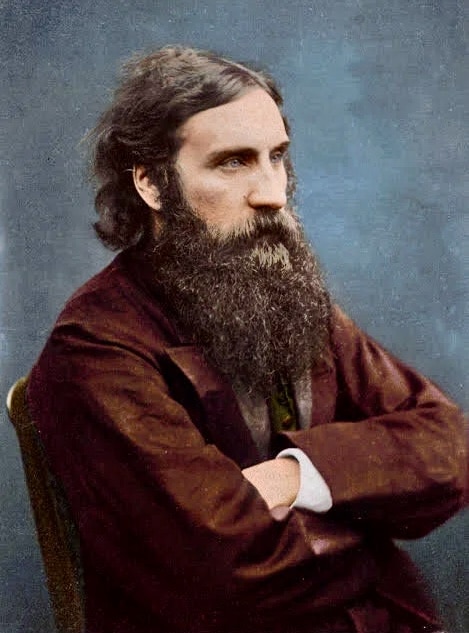
George Macdonald was born in Huntly, in the western part of Aberdeenshire, Scotland, the son of a farmer and his wife Helen MacKay (1790-1832). He was educated in country schools where Gaelic myths and Old Testament stories were common currency. At King’s College, Aberdeen from 1840, he studied Moral Philosophy and Sciences and went on to prepare for the Congregationalist ministry at Highbury College, London. In 1850 he became pastor of a dissenting chapel in Arundel, West Sussex, but resigned after three years. The Deacons had complained that he was tainted with liberal German theology, and was guilty of heretical belief in a future state of probation for heathens. Rejecting the rigid Calvinist doctrine of ‘predestination’, but not its focus on the nature of sin and grace, he came to believe that everyone was capable of being saved:
‘I believe that no man is ever condemned for any sin except one – that he will not leave his sins and come out of them, and be the child of him who is his Father.’[1]
In 1851 he married Louisa Powell (1822-1902) and they had six sons and five daughters. Despite a successful career as a published writer, he was continually forced to rely on the charity of others. Lady Byron (1792-1860) and John Ruskin (1819-1900) became patrons. Mark Twain (1835-1910), G.K. Chesterton (1874-1936), H.W. Longfellow (1807-82) and Walt Whitman (1819-92) were among his friends. He became an Anglican under the influence of F.D. Maurice (1805-72), who is commonly regarded as the founder of Christian Socialism. In the 1870s he toured and lectured in America, being well-received by big audiences and writers such as R.W. Emerson (1803-82). In 1877 ill-health, that had dogged him for much of his life, led him to seek the warmer climate of the Mediterranean and he spent most of the years from 1881 to 1902 in Bordighera, Italy. After a long illness, he died in Ashstead, Surrey.
J.R.R. Tolkien (1892-1973) was influenced by his writings, as was C.S. Lewis (1898-1963) who paid this tribute to George MacDonald: ’I have never concealed the fact that I regarded him as my master; indeed I fancy I have never written a book in which I did not quote from him.’[2] He also summarised two key foundations of MacDonald’s belief: First, ’From his own father, he said, he first learned that Fatherhood must be at the core of the universe. He was thus prepared in an unusual way to teach that religion in which the relation of Father and Son is, of all relations, the most central.’[3] Second, ‘The Divine Sonship is the key conception which unites all the different elements of his thought…. I know hardly any other writer who seems to be closer, or more continually close, to the Spirit of Christ Himself. Hence his Christ-like union of tenderness and severity.’[4]
The headlines of the twelve following sections derive from this compiler’s paper: ‘FAITH MARKERS: Evangelical and Anglican Statements of Faith’ (1215 to the Present Day) which can be found at www.oxford.academia.edu/IanBunting This paper must not be interpreted as an attempt to colonise the poet.
- Our Father: Hallowed on Earth as in Heaven
Creation’s ‘work by faint degrees’
Creation Thou dost work by faint degrees,
By shade and shadow from unseen beginning;
Far, far apart, in unthought mysteries
Of thy own dark, unfathomable seas,
Thou will’st thy will; and thence, upon the earth –
Slow travelling, his way through centuries winning –
A child at lengthy arrives at never ending birth.
Well mayst thou then work on indocile hearts
By small successes, disappointments small;
By nature, weather, failure, or sore fall;
By shame anxiety, bitterness and smarts;
By loneliness, by weary loss of zest: –
The rags, the husks, the swine, the hunger quest,
Drive home the wanderer to the Father’s breast.[5]
‘Nature’
In what belongs to the deeper meanings of nature and her mediation between us and God, the appearances of nature are the truths of nature, far deeper than any scientific discoveries in and concerning them. The show of things is that for which God cares most, for their show is the face of far deeper things than they…. So nature… exists primarily for her face, her look, her appeals to the heart and the imagination, her simple service to human need, and not for the secrets to be discovered in her and turned to man’s further use.[6]
‘God draws the child ‘in every flower he sees’
Some way there must be of my not forgetting,
And thither thou art leading me, my God.
The child that, weary of his mother’s petting,
Runs out the moment that his feet are shod,
May see her face in every flower he sees;
And she, although beyond the window sitting,
Be nearer him than when he sat upon her knees.[7]
‘The flower is not its loveliness’
If the flowers were not perishable, we should cease to contemplate their beauty, either blinded by the passion for hoarding the bodies of them, or dulled by the hebetude of commonplaceness that the constant presence of them would occasion…. The flower is not its loveliness, and its loveliness we must love, else we shall only treat them as flower-greedy children, who gather and gather, and fill hands and baskets from a mere desire of acquisition.[8]
‘The wilful torture of multitudes of His creatures’
He knows his horses and his dogs as we cannot know them, because we are not yet pure sons of God. When through our sonship, as Paul teaches, the redemption of these lower brothers and sisters shall have come, then we shall understand each other better. But now the Lord of Life has to look on the wilful torture of multitudes of His creatures. It must be that offences come, but woe unto that man by whom they come! The Lord may not seem to heed, but He sees and knows.[9]
‘God lifts me to my ‘spirit-home’
Ever above my coldness and my doubt
Rises up something, reaching forth a hand:
This thing I know, but cannot understand.
Is it God in me that rises out
Beyond myself, trailing it up with him
Toward the spirit-home, the freedom land,
Beyond my conscious ken, my near horizon’s brim?[10]
- The Bible: Bestowed Word of God
Christ: ‘The ever unfolding Revelation of God’
But herein is the Bible itself greatly wronged. It nowhere lays claim to be regarded as the Word, the Way, the Truth. The Bible leads us to Jesus, the inexhaustible, the ever unfolding. Revelation of God. It is Christ ‘in whom are hid all the treasures of wisdom and knowledge’, not the Bible, save as leading to Him.[11]
Why we have not ‘His very words’
God has not cared that we should anywhere have assurance of His very words; and that not merely perhaps, because of the tendency in His children to word-worship, false logic, and corruption of the truth, but because He would not have them oppressed by words, seeing that words, being human, therefore but partially capable, could not absolutely contain or express what the Lord meant, and that even He must depend for being understood upon the spirit of His disciple. Seeing it could not give life, the letter should not be throned with power to kill.[12]
The Law: ‘reinforcement of life’
The immediate end of the commandments never was that men should succeed in obeying them, but that, finding they could not do that which yet must be done, finding the more they tried the more was required of them, they should be driven to the source of life and law – of their life and His law – to seek from Him such reinforcement of life as should make the fulfilment of the law as possible, yea, as natural, as necessary.[13]
3. Jesus Christ; Crucified God in person
Christ: ‘creator of righteousness in us’
Christ is our righteousness, not that we should escape punishment, still less escape being righteous, but as the living potent creator of righteousness in us, so the we, with our wills receiving His spirit, shall like him resist unto blood, striving against sin.[14]
Salvation ’from their sins’
The notion that the salvation of Jesus is a salvation from the consequences of our sins is a false, mean, low notion…. Jesus did not die to save us from punishment; He was called Jesus because He should save His people from their sins.[15]
God’s ‘consuming fire’
Such is the mercy of God that He will hold His children in the consuming fire of His distance until they pay the uttermost farthing, until thy drop the purse of selfishness with all the dross that is in it, and rush home to the Father and the Son and the many brethren – rush inside the centre of the life-giving fire whose outer circles burn.[16]
‘I shall one day be better’
I to myself have neither power nor worth,
Patience nor love, nor anything right good;
My soul is a poor land, plenteous in dearth –
Here blades of grass, there is a small herb for food –
A nothing that would be something if it could;
But if obedience, Lord, in me do grow,
I shall one day be better than I know.[17]
Christ ‘in the inner world of men shall rise’
And Christ, whom they did hang ‘twixt earth and skies,
Up in the inner world of men shall rise.
Make me a fellow worker with thee Christ:
Nought else befits a God-born energy;
Of all that’s lovely, only lives the highest,
Lifting the rest that it shall never die.
Up I would be to help thee – for thou liest
Not, linen-swathed in Joseph’s garden-tomb,
But walkest crowned, creation’s heart and bloom.[18]
- Humanity: Sinful, Rebellious and Faithless
‘I knew not till my soul was dark’
I missed him when the sun began to bend;
I found him not when I had lost his rim;
With many tears I went in search of him,
Climbing high mountains which did still ascend,
And gave me echoes when I called my friend;
Through cities vast and charnel-houses grim,
And high cathedrals where the light was dim,
Through books and arts and works without an end,
But found him not – the friend whom I had lost.
And yet I found him – as I found the lark,
A sound in fields I heard but could not mark:
I found him nearest when I missed him most;
I found him in my heart, a life in frost,
A light I knew not till my soul was dark.[19]
‘The thing defaced is His image’
No matter how His image may have been defaced in me, the thing defaced is His image, remains His defaced image – an image yet, that can hear His word. What makes me evil and miserable is that the thing spoiled in me is the image of the Perfect…. No, no! Nothing can make it that I am not the child of God. If one say, ’Look at the animals: God made them; you do not call them the children of God!’ I answer, ‘But I am to blame: they are not to blame! I cling fast to my blame: it is the seal of my childhood.’ I have nothing to argue from in the animals, for I do not understand them. Two things I am sure of: that God is ‘a faithful creator’ and that the sooner I put in force my claim to be a child of God, the better for them; for they too are fallen, though without blame.[20]
Avarice
It is the desire to call things ours – the desire of company which is not of our kind – company such as, if small enough, you would put in your pocket and carry about with you. We call the holding in the hand, or the house, or the pocket, or the power, having: but things so held cannot really be had; having is but an illusion in regard to things. It is only what we can be with that we really possess – that is, – what is of our own kind, from God to the lowest animal partaking of humanity.[21]
Self-control: ‘diseased satisfaction’
The diseased satisfaction which some minds feel in laying burdens on themselves, is a pampering, little as they may suspect it, of the most dangerous appetite of that self which they think they are mortifying.[22]
‘Poor as a withered leaf’
Thou hungerest not, thou thirstiest not enough.
Thou art a temporizing thing, mean heart.
Down-drawn, thou pick’st up straws and wretched stuff,
Stooping as if the world’s floor were the chart
Of the long way thy lazy feet must tread.
Thou dreamest of the crown hung o’er thy head –
But that is safe: thou gatherest hairs and fluff…!
Poor am I, God knows, poor as withered leaf….[23]
5. The Grace of God: Justifying and Converting
‘To be ashamed is a holy, blessed thing’
We may trust God with our past as heartily as with our future. It will not hurt so long as we do not try to hide things, so long as we are ready to bow our heads in hearty shame where it is fit we should be ashamed. For to be ashamed is a holy, blessed thing. Shame is a thing to shame only those who want to appear, not those who want to be. Shame is to shame those who want to pass their examination, not those who would get into the heart of things…. To be humbly ashamed is to be plunged in the cleansing bath of truth.[24]
‘Free, from the low self, loathed of the higher me’
How many helps thou giv’st to those would learn!
To some sore pain, to others a sinking heart;
To some a weariness worse than any smart;
To some a haunting, fearing, blind concern;
Madness to some; to some the shaking dart
Of hideous death still following as they turn;
To some a hunger that will not depart.
To some thou giv’st a deep unrest – a scorn
Of all they are or see upon the earth;
A gaze, at dusky night and clearing morn,
As on a land of emptiness and dearth;
To some a bitter sorrow; to some the sting
Of love misprized – of sick abandoning;
To some a frozen heart, oh, worse than anything!…
But now the Spirit and I are one in this –
My hunger now is after righteousness;
My spirit hopes in God to set me free
From the low self, loathed of the higher me.
Great elder brother of my second birth,
Dear o’er all names but one, in heaven or earth,
Teach me all day to love eternally.[25]
In the ‘consuming fire of God’s distance’
Such is the mercy of God that he will hold his children in the consuming fire of his distance until they pay the uttermost farthing, until they drop the purse of selfishness with all the dross that is in it, and rush home to the Father and the Son and the many brethren – rush inside the centre of the life-giving fire.[26]
‘The one thing that cannot be forgiven’
‘I thank Thee, Lord, for forgiving me, but I prefer staying in the darkness: forgive me that too.’ – ‘No; that cannot be. The one thing that cannot be forgiven is the sin of choosing to be evil, of refusing deliverance. It is impossible to forgive that. It would be to take part in it.’[27]
‘Every sin meets with its due fate’
No man who will not forgive his neighbour, can believe that God is willing, yea wanting, to forgive him…. The man would think, not that God loved the sinner, but that he forgave the sin, which God never does [i.e. what is usually called ‘forgiving the sin’ means forgiving the sinner and destroying the sin]. Every sin meets with its due fate – inexorable expulsion from the paradise of God’s Humanity. He loves the sinner so much that He cannot forgive him in any other way than by banishing from his bosom the demon that possesses him.[28]
‘The finding of our deeper, our true self’
Vain were the fancy, by treatise, or sermon, or poem, or tale, to persuade a man to forget himself. He cannot if he would. Sooner will he forget the presence of a raging tooth. There is no forgetting of our selves but the finding of our deeper, our true self – God’s idea of us when he devised us –the Christ in us. Nothing but that self can displace the false, greedy, whining self, of which most of us are so fond and proud. And that self no man can find for himself… ‘But as many as received Him (Christ), to them gave He power to become the sons of God.’[29]
- Christian Living: Progressive Christ-likeness
‘No longer regent of our action’
The self is given to us that we may sacrifice it; it is ours, that we, like Christ, may have somewhat to offer…. It means this: we must refuse, abandon, deny self altogether as a ruling, or determining, or originating element in us. It is to be no longer regent of our action. We are no more to think, ‘What should I like to do?’ but, ‘What would the Living One have me do?’[30]
‘My potter: ‘make a vessel of thy yielding clay’
Here, O my potter, is thy making-stuff!
Set thy wheel going; let it whir and play.
The chips in me, the stones, the straw, the sand,
Cast them out with fine separating hand,
And make a vessel of thy yielding clay.[31]
Lord: ‘At centre of thought’s swift-revolving wheel’
Lord, set me from self-inspiration free,
And let me live and think from thee, not me –
Rather, from deepest me then think and feel,
At centre of thought’s swift-revolving wheel.[32]
‘Fill my tent with laughing morn’s delight’
Not thine, my Lord, the darkness all is mine –
Save that, as mine, my darkness too is thine:
All things are thine to save or to destroy –
Destroy my darkness, rise my perfect joy;
Love primal, the live coal of every night,
Flame out, scare the ill things with radiant fright
And fill my tent with laughing morn’s delight.[33]
‘My mirror-heart thy shining place’
From sleep I wake, and wake to think of thee.
But wherefore not with sudden glorious glee?…
Is it because it is not thou I see,
But only my poor, blotted fancy of thee?
Oh, never till thyself reveal thy face,
Shall I be flooded with life’s vital grace!
Oh make my mirror-heart thy shining place,
And the my soul, awaking with the morn,
Shall be a waking joy, eternally new-born.[34]
‘Likeness to Christ is the truth of a man’
His likeness to Christ is the truth of a man, even as the perfect meaning of a flower is the truth of a flower…. As Christ is the blossom of humanity, so the blossom of every man is the Christ perfected in him.[35]
Christ: ‘is the live Truth’
When a man is, with his whole nature, loving and willing the truth, he is then a live truth. But this he has not originated in himself. He has seen and striven for it, but not originated it. The more originating, living, visible truth, embracing all truths in all relations, is Jesus Christ. He is true: He is the live Truth.[36]
‘Love is born in us’
In the main we love because we cannot help it. There is no merit in it: how should there be any love? But neither is it selfish…. Yet the love that is born in us is our salvation from selfishness. It is the very essence of righteousness.[37]
‘The wide-awake real’
To believe in the wide-awake real, through all the stupefying, enervating distorting dream: to will to wake, when the very being seems athirst for Godless repose: – these are the broken steps up to the high fields where repose is but a form of strength, strength but a form of joy, joy but a form of love. [38]
- Holy Spirit: in Christian Experience
‘Nearer now than when eye-seen on earth’
Thou knowest all our weeping, fainting, striving;
Thou know’st how very hard it is to be;
How hard to rouse faint will not yet reviving;
To do the pure thing, trusting all to thee;
To hold thou art there, for all no face we see;
How hard to think, through cold and dark and dearth,
That thou art nearer now than when eye-seen on earth….
To my dim lattice, O calling Christ! I go,
And out into the dark look for thy star-crowned head.[39]
8. Believers: Assured, Called and Prayerful
‘Doubt must precede every deeper assurance’
Doubts are the messengers of the Living One to the honest. They are the first knock at our door of things that are not yet, but have to be, understood…. Doubt must precede every deeper assurance; for uncertainties are what we first see when we look into a region hitherto unknown, unexplored, unannexed.[40]
‘Walk by the other light supreme’
Lord, loosen in me the hold of visible things;
Help me to walk by faith and not by sight;
I would, through thickest veils and coverings,
See into the chambers of the living light.
Lord, in the land of things that swell and seem,
Help me to walk by the other light supreme
Which shows thy facts behind man’s vaguely hinting dream.[41]
‘The Godlike silence of a loving care’
With thee on board, each sailor is a king,
Nor I mere captain of my vessel then,
But heir of earth and heaven, eternal child;
Daring all truth, nor fearing anything;
Mighty in love, the servant of all men;
Resenting nothing, taking rage and blare
Into the Godlike silence of a loving care.[42]
Prayer
‘O God!’ I cried and that was all. But what are the prayers of the whole universe more than expansion of that one cry? It is not what God can give us, but God that we want.[43]
My ‘poor half-fledged prayer-bird’
Sometimes, hard-trying, it seems I cannot pray-
For doubt, and pain, and anger, and all strife.
Yet some poor half-fledged prayer-bird from the nest
May fall, flit, fly, perch – crouch in the bowery breast
Of the large nation-healing tree of life;-
Moveless there sit through all the burning day,
And on my heart at night a fresh leaf cooling lay.[44]
Beyond where I can feel, read thou the prayer
My prayer-bird was cold – would not away,
Although I set it on the edge of the nest.
Then I bethought me of the old story –
Love-fact or loving fable, thou know’st best-
How, when the children had made sparrows of the clay,
Thou mad’st them birds, with wings to flutter and fold:
Take, Lord, my prayer in thy hand, and make it pray.
Poor clay-sparrow seems turned to a stone,
And from my heart will neither fly nor run….
Look deep, yet deeper, in my heart, and there,
Beyond where I can feel, read thou the prayer.[45]
‘Thy peace is strangely wrought’
My prayers, my God, flow from what I am not;
I think thy answers make me what I am.
Like weary waves thought follows upon thought,
But still the depth beneath is all thine own,
And there thou mov’st in paths to us unknown,
Out of strange strife thy peace is strangely wrought;
If the lion in us pray – thou answerest the lamb.[46]
Corrective Granting
Even such as ask amiss may sometimes have their prayers answered. The Father will never give the child a stone that asks for bread; but I am not sure the He will never give the child a stone that asks for a stone. If the Father says, ‘My child, that is a stone; it is no bread’, and the child answer, ‘I am sure it is bread; I want it’, may it not be well that he should try his ‘bread’?[47]
- The Necessity of the Church
Church or chapel is not the place for divine service. It is a place of prayer, a place of praise, a place to feed upon good things, a place to learn of God, as what place is not? It is a place to look in the eyes of your neighbour, and love God along with him. But the world in which you move, the place of your living and loving and labour, not the church you go to on your holiday, is the place of divine service. Serve your neighbour, and you serve him.[48]
‘There are those who… turn their backs and go to church’
There are those who in their very first seeking of it are nearer to the Kingdom of Heaven than many who have for years believed themselves of it. In the former there is more of the mind of Jesus, and when He calls them they recognise Him at once and go after Him; while the others examine Him from head to foot, and finding Him not sufficiently like the Jesus of their conception, turn their backs and go to church or chapel or chamber to kneel before a vague form mingled of tradition and fancy.[49]
‘Low sinks the threshold’
I see a door, a multitude near by,
In creed and quarrel, sure disciples all!
Gladly they would, they say, enter the hall,
But cannot, the stone threshold is so high….
But see, one comes; he listens to the voice;
Careful he wipes his weary dusty feet!
The voice hath spoken – to him is left no choice;
He hurries to obey – that only is meet.
Low sinks the threshold, levelled with the ground;
The man leaps in – to liberty he’s bound.
The rest go talking, walking, picking round.[50]
‘The support of other presences’
Without the correction, the reflection, the support of other presences, being is not merely unsafe, it is a horror – for anyone but God, who is His own being. For Him whose idea is God’s, the image of God, his own being is far too fragmentary and imperfect to be anything like good company. It is the lovely creatures God has made all around us, in them giving us Himself, that, until we know Him, save us from the frenzy of aloneness – for that aloneness in self.[51]
The preacher on watch
He’s got a good telescope, and he gets to the masthead, and he looks out. And he sings out, ‘Land ahead,’ or ‘Breakers ahead,’ and gives directions according! Only I can’t always make out what he says. But when he shuts up his spyglass, and comes down the rigging, and talks to us like one man to another, then I don’t know what I should do without the parson.[52]
Preacher’s Repentance
O Lord, I have been talking to the people;
Thought’s wheels have round me whirled a fiery zone,
And the recoil of my word’s airy ripple
My heart heedful has puffed up and blown.
Therefore I cast myself before Thee prone:
Lay cool hands on my burning brain and press
From my weak heart the swirling emptiness.[53]
- The Mission of God
‘His yoke is easy, His burden light’
The will of the Father is the yoke He would have us take, and bear also with Him. It is of this yoke that he says It is easy, of this burden It is light. He is not saying ‘The yoke I lay upon you is easy, the burden light’; what he says is, ‘The yoke I carry is easy, the burden on my shoulders is light’. With the garden of Gethsemane before Him, with the hour and power of darkness waiting for Him, He declares His yoke is easy, His burden light’.[54]
‘It is essential, first, that the giver be in the gift’
For the real good of every gift it is essential, first, that the giver be in the gift – as God always is, for he is love – and next, that the receiver know and receive the giver in the gift. Every gift of God is but the harbinger of his greatest and only sufficing gift – that of himself.[55]
‘It is the Giver he must have’
The heart of man cannot hoard. His brain or his hand may gather into its box and hoard, but the moment the thing has passed into the box, the heart has lost it and is hungry again. If a man would have, it is the Giver he must have…. Therefore all that He makes must be free to come and go through the heart of His child; he can enjoy it only as it passes, can enjoy only its life, its soul, its vision, its meaning, not itself.[56]
11. The Vision of Moral Justice
‘The justice of God’
Let us come nearer to knowing what we ought to understand by justice, that is, the justice of God; for his justice is the live, active justice, giving existence to the idea of justice in our minds and hearts. Because he is just, we are capable of knowing justice; it is because he is just, that we have the idea of justice so deeply imbedded in us.[57]
12. Glory: Now and Then, Here and There
‘He will have purity’
God is a consuming fire that only that which cannot be consumed may stand forth eternal. It is the nature of God, so terribly pure that it destroys all that is not pure as fire, which demands like purity in our worship. He will have purity. It is not that the fire will burn us if we do not thus worship but that the fire will burn us until we worship thus, yea, will go on burning within us after all that is foreign to it has yielded to its force, no longer with pain and consuming, but as the highest consciousness of life, the presence of God.[58]
‘Open you hand, and you will sleep indeed’
‘Lilith’, said Mara, ‘you will not sleep, if you lie there a thousand years, until you have opened your hand and yielded that which is not yours to give or to withhold.’
‘I cannot,’ she answered, ‘I would if I could, for I am weary, and the shadows of death are gathering around me’ –
‘They will gather and gather, but they cannot enfold you while yet your hand remains unopened. You may think you are dead, but it will only be a dream. Open your hand, and you will sleep indeed – then wake indeed’ –
I am trying hard, but the fingers have grown together in the palm’ –
I pray you put forth the strength of your will. For the love of life, draw together your forces and break its bonds!’
The princess turned her eyes upon Eve, beseechingly. ‘There was a sword I once saw in your husband’s hands’, she murmured. ‘I fled when I saw it, I heard him who bore it say it would divide whatever was not one and indivisible’.
‘I have the sword’, said Adam. ‘The angel gave it me when he left the gate.’
‘Bring it, Adam,’ pleaded Lilith, ‘and cut me off this hand that I may sleep.’
‘I will,’ he answered.[59]
‘No less than my real, deeper life, my love’
Well may this body poorer, feebler grow!
It is undressing for its last sweet bed;
But why should the soul, which death shall never know,
Authority and power, and memory shed?
It is that Love with absolute Faith should wed;
God takes the inmost garments off his child
To have him in his arms, naked and undefiled.
Thou art my knowledge and my memory,
No less than my real, deeper life, my love….[60]
‘I shall awake… at one with him and free’
Christ is the pledge that I shall one day see;
That one day, still with him, I shall awake,
And know my god, at one with him and free.
O lordly essence, come to life in me….[61]
‘Our all-right place’
The only air of the soul, in which it can breathe and live, is the present God and the spirits of the just: that is our heaven, our home, our all-right place….[62]
Notes:
[1] UNSPOKEN SERMONS, Third Series, Justice, 1889. Grand Rapids, Ml, Christian Classics Ethereal Library, p. 59.
[2] George MacDonald: An Anthology, edited with a Preface by C.S. Lewis, London, Geoffrey Bles, 1946, p. 33.
[3] Anthology 1946:21.
[4] Anthology 1946:31.
[5] George MacDonald, The Diary of an Old Soul (1880), London, George Allen and Unwin, 1905, p. 92.
[6] UNSPOKEN SERMONS, Second Series, The Voice of Job, 1885.
[7] The Diary of an Old Soul, 23rd August, 1880.
[8] The Seaboard Parish, Chapter 19, 1868.
[9] UNSPOKEN SERMONS, Third Series, The Inheritance, 1889.
[10] The Diary of an Old Soul, 23rd May, 1880.
[11] UNSPOKEN SERMONS, First Series, The Higher Faith, 1867.
[12] UNSPOKEN SERMONS, Third Series, The Knowing of the Son, 1889.
[13] UNSPOKEN SERMONS, Second Series, The Way, 1885.
[14] UNSPOKEN SERMONS, Second Series, The Last Farthing, 1885.
[15] UNSPOKEN SERMONS, Third Series, Justice, 1889.
[16] UNSPOKEN SERMONS, Third Series, Justice, 1889.
[17] The Diary of an Old Soul, 1st February, 1880.
[18] The Diary of an Old Soul, 4th & 5th June, 1880.
[19] Lost and Found, in The Oxford Book of English Mystical Verse, Nicholson and Lee (eds.), Oxford, The Clarendon Press, 1917.
[20] UNSPOKEN SERMONS, Second Series, Abba, Father, 1885.
[21] What’s Mine’s Mine, Chapter 32, 1886.
[22] UNSPOKEN SERMONS, Second Series, Self-Denial, 1885.
[23] The Diary of an Old Soul, 6th & 8th September. 1880.
[24] UNSPOKEN SERMONS, Third Series, The Final Unmasking, 1889.
[25] The Diary of an Old Soul, 16th, 17th and 20th June.
[26] UNSPOKEN SERMONS, Third Series, Justice. 1889.
[27] UNSPOKEN SERMONS, Third Series, Light, 1889.
[28] UNSPOKEN SERMONS, First Series, It shall not be forgiven, 1867.
[29] Sir Gibbie, Chapter 24, 1879.
[30] UNSPOKEN SERMONS, Second Series, Self-Denial, 1885.
[31] The Diary of an Old Soul, 11th October, 1880.
[32] The Diary of an Old Soul, 28th June, 1880.
[33] The Diary of an Old Soul, 4th July, 1880.
[34] The Diary of an Old Soul, 6th & 7th October, 1880.
[35] UNSPOKEN SERMONS, Third Series, The Truth, 1889.
[36] UNSPOKEN SERMONS, Third Series, The Truth, 1889.
[37] UNSPOKEN SERMONS, Second Series, Self-denial, 1885.
[38] UNSPOKEN SERMONS, Second Series, Life, 1885.
[39] The Diary of an Old Soul, 2nd & 5th November, 1880.
[40] UNSPOKEN SERMONS, Second Series, The Voice of Job, 1885.
[41] The Diary of an Old Soul, 25th September.
[42] The Diary of an Old Soul, 22nd February, 1880.
[43] Wilfrid Cumbermede,1872, Chapter 59.
[44] The Diary of an Old Soul, 14th January, 1880.
[45] The Diary of an Old Soul, 14th & 15th November, 1880.
[46] The Diary of an Old Soul, 26th May.
[47] UNSPOKEN SERMONS, Second Series, Man’s Difficulty Concerning Prayer, 1885.
[48] UNSPOKEN SERMONS, Third Series, Righteousness, 1889.
[49] Thomas Wingfold, Curate, 1876, Chapter 36, 1876.
[50] The Diary of an Old Soul, 16th and 18th April, 1880.
[51] UNSPOKEN SERMONS, Second Series, The Last Farthing, 1885.
[52] Annals of a Quiet Neighbourhood , 1867.
[53] The Diary of an Old Soul, 31st January, 1880.
[54] UNSPOKEN SERMONS, Second Series, Self-Denial, 1885.
[55] UNSPOKEN SERMONS, Second Series, The Word of Jesus on Prayer, 1885.
[56] The Seaboard Parish, Chapter 32, 1868.
[57] UNSPOKEN SERMONS, Third Series, Justice, 1889.
[58] UNSPOKEN SERMONS, First Series, The Consuming Fire, 1867.
[59] What’s Mine’s Mine, Chapter 40, 1895.
[60] The Diary of an Old Soul, 11th & 12th August. 1880.
[61] The Diary of an Old Soul, 10th May. 1880.
[62] UNSPOKEN SERMONS, Second Series, The Cause of Spiritual Stupidity, 1885.
07.04.2026

https://shorturl.fm/Fv1GH
Correction: he did not believe everyone was just capable of being saved, but that everyone WOULD be saved. For it is God’s will, 1 Tim 2:4 . To deny the ultimate redemption of ALL is to diminish Christ and the father’s work. Otherwise, a beautiful page.